1800 84 90 84 sale@doornosh.com

How to Choose the Right PVDF Air Dome?

Choosing the right Pvdf Air Dome starts with the job it must perform, not its appearance. Will it cover a sports court, warehouse, event space, or another facility? Each use brings different demands for clear span, access, ventilation, lighting, and operating hours. The product name alone does not explain the membrane’s construction. Ask whether PVDF is used as a surface coating, and request details about the base fabric, seams, and stated performance. Small print matters.

Next, match the dome’s design to its site. Wind, snow, temperature swings, drainage, and exposure to sunlight can affect material choices and operating requirements. Compare documented load data, fire-performance information, warranty terms, and maintenance guidance; have qualified professionals review site-specific engineering. Check the blower system, backup arrangements, anchoring plan, and expected energy use, too. A low purchase price can hide costs in operation or upkeep.

Walk the proposed site before comparing quotations. Note the ground conditions, nearby structures, vehicle access, and where equipment will sit. Ask suppliers how installation, inspection, repairs, and eventual membrane replacement are handled. Request clear drawings and written specifications rather than relying on attractive renderings. No option is perfect. A membrane suited to one climate may be a poor fit elsewhere, and a supplier’s broad claims need evidence. Careful questions help turn a promising dome into a practical, dependable space.
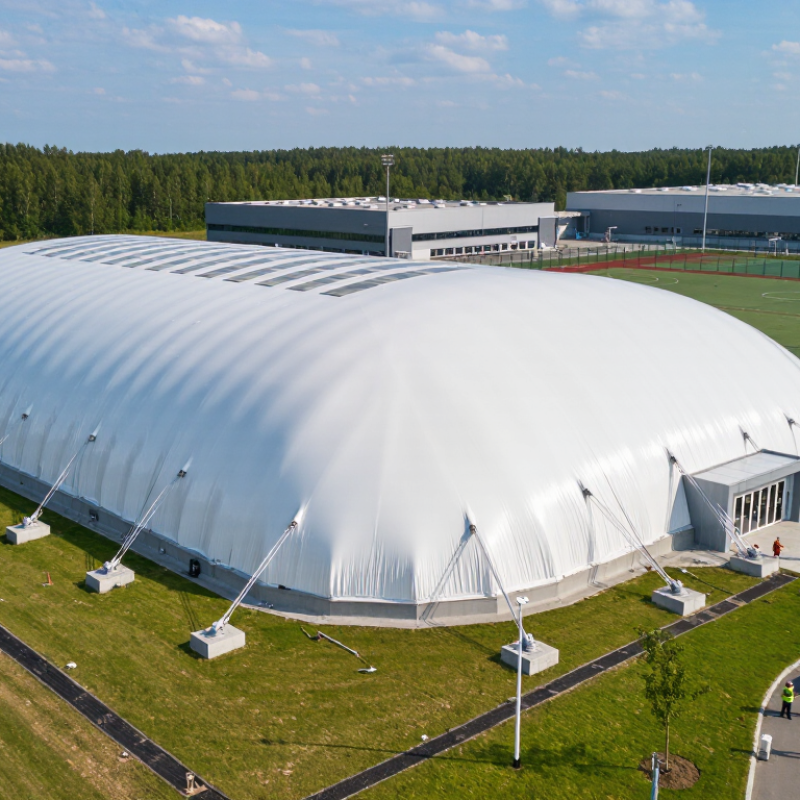
How to Choose the Right PVDF Air Dome?

Understanding PVDF Air Domes and Their Main Components

A PVDF air dome is an air-supported enclosure covered by a flexible membrane. PVDF commonly describes a protective coating applied to woven fabric, often polyester. The coating helps the surface withstand weathering, but it does not make every membrane equally durable. Fabric weight, coating thickness, seam quality, and exposure to sunlight all matter. Check technical data against the expected climate and use.

The membrane is only one part of the system. Blowers maintain interior pressure, while control equipment monitors pressure and can alert operators to changes. Airlocks help people enter without releasing too much air. Cables, perimeter connections, and anchors transfer loads to the supporting foundation. Each part affects performance. A strong fabric cannot compensate for poorly planned anchorage or inadequate pressure control. Real sites are messy, and a clean drawing may not capture every wind exposure or access need.

Tips: Ask how seams are tested and how often controls need inspection. Confirm backup power arrangements and maintenance access before choosing a dome. Look closely at the anchorage details. That step is easy to overlook. If possible, have a qualified specialist review site conditions and system specifications; one detail may still need revisiting after installation.

Defining Site Conditions and Intended Use

Choosing a PVDF air dome starts with the ground beneath it and the weather around it. Record the site’s elevation, prevailing wind direction, seasonal snowfall, rainfall, and temperature range. NOAA’s 2023 U.S. Billion-Dollar Weather and Climate Disasters report counted 28 costly weather events, underscoring why regional hazard records matter. That national figure is context, not a substitute for local design data. Check drainage after heavy rain, too; a low, waterlogged entrance can become a daily problem.

Ask a geotechnical professional to assess soil strength, groundwater, and anchoring conditions. Then match the dome to its intended use: a sports hall needs clear-span space, lighting, and fresh-air planning; storage may need different access and temperature controls. ASCE/SEI 7-22 provides site-specific criteria for wind, snow, rain, and seismic loads. Use the applicable local design inputs, not a generic “typical” value. Small differences matter.

Also consider how the site will operate. Where will power equipment sit? Can service vehicles reach it in winter? Will nearby buildings create wind turbulence? Air-supported structures depend on controlled internal pressure, so assess backup power, monitoring, and access for maintenance. A detail that looks minor on a drawing may be awkward in real use. I would revisit the plan with the operator before fixing the footprint.

Selecting the Right PVDF Membrane Specifications

For a PVDF air dome, start with the design loads, not a catalogue’s highest strength figure. Ask for warp and weft tensile strength, tear resistance, coating weight, and total membrane mass. These values describe different properties; one impressive number cannot replace the others. Match them to the dome’s span, operating pressure, wind exposure, and expected snow conditions, as confirmed by the project engineer.

Check how the membrane handles daylight, temperature changes, and repeated flexing. A bright interior may reduce daytime lighting needs, but too much glare can make work areas uncomfortable. Request test data for light transmission, weathering, and fire performance, plus details about the intended service life. The seam matters, too. Confirm that the specified membrane can be welded reliably, and review seam-strength results rather than relying on the sheet strength alone. Small details matter.

Ask for samples and inspect the coating, fabric surface, and welded joints under good light. Compare documentation with the actual product batch. A neat specification sheet can still leave questions about installation or maintenance. I would not treat any single rating as proof of durability; real performance depends on the whole assembly and local conditions.

Evaluating Structural, Climate, and Operational Requirements

How to Choose the Right PVDF Air Dome?
Evaluating Structural, Climate, and Operational Requirements

A PVDF air dome must suit its site, not just its floor plan. Start with clear spans, intended use, and local wind and snow conditions. Ask a qualified structural professional to check membrane strength, cable layout, anchoring, and operating pressure together. A strong fabric alone cannot compensate for weak foundations. Small details matter.

Climate changes the specification. In snowy regions, the dome may need reliable heating and airflow to limit accumulation. In hot, humid areas, insulation, ventilation, and condensation control deserve closer attention. Consider temperature swings, driving rain, and nearby trees that can shed debris. A tidy calculation may still miss a difficult site condition; review assumptions against actual weather records.

Daily operations shape long-term performance. Estimate occupancy, door openings, lighting, and equipment heat before sizing the air-handling system. Include backup power, pressure alarms, and a clear evacuation plan in the operating design. Ask how filters, fans, and membrane sections will be inspected and reached. Maintenance access is easy to overlook. Compare energy use and repair access, not only purchase cost. Even a careful forecast can be wrong, so leave room to adjust controls after the dome is in use.

How to Choose the Right PVDF Air Dome? - Evaluating Structural, Climate, and Operational Requirements

Evaluation Area Requirement to Define What to Check Selection Guidance
Intended use and clear span Activities, occupancy, equipment, required playing or working area, and clear height. Layout drawings, unobstructed-span requirements, access routes, and any suspended equipment or lighting. Choose a geometry and size that meet the usable-space requirement, not just the overall footprint. Confirm that planned equipment loads and attachments are included in the structural design.
Membrane construction Fabric type, coating system, layer arrangement, and project-specific performance needs. Technical datasheets and test documentation for the membrane’s tensile properties, coating, seams, and relevant durability characteristics. PVDF is a surface coating, not the structural fabric itself. Verify the complete membrane build-up and test methods rather than comparing the coating name alone.
Wind exposure Site wind conditions, terrain exposure, surrounding obstructions, and applicable design-code requirements. Site-specific design calculations, design wind speed and pressure assumptions, anchorage details, and engineering documentation. Require a design based on the actual site and applicable local codes. Do not rely on a generic wind rating without checking its assumptions and scope.
Snow and ice Local snow and ice conditions, roof geometry, and the planned snow-management approach. Design snow-load assumptions, membrane shape, monitoring procedures, and any heating or snow-clearing provisions. Confirm that snow loads and operating procedures are addressed together. Snow-management measures should be designed for the project and should not substitute for required structural capacity.
Temperature and climate Expected outdoor temperature range, solar exposure, humidity, rainfall, and seasonal operating conditions. Membrane temperature limits, interior comfort targets, heating and cooling capacity, and the design basis for local climate. Match the enclosure and HVAC strategy to the climate and intended occupancy. Ask for documented material limits instead of assuming one membrane specification suits every location.
Air pressure and envelope Required operating pressure, allowable air leakage, door use, and expected occupancy patterns. Pressure-control design, monitoring and alarm functions, entrance or airlock arrangements, and commissioning procedures. Air-supported structures rely on controlled internal pressure. Check that pressure management is coordinated with the envelope, entrances, and operating plan.
Blowers and backup power Required airflow and pressure under normal operation and during foreseeable equipment or power interruptions. Blower capacity and redundancy, automatic changeover, backup-power provisions, alarms, and documented emergency procedures. Assess the full failure-response plan, not just the number of blowers. Confirm how the system detects a fault and how personnel are notified and instructed to respond.
Ventilation and condensation Occupant load, indoor air-quality needs, moisture generation, and temperature differences across the enclosure. Ventilation design, humidity-control strategy, drainage details, and assessment of condensation risk. Coordinate ventilation and moisture control with heating and cooling. The appropriate solution depends on the activity, climate, envelope, and occupancy.
Fire and life safety Applicable building and fire regulations, occupancy classification, and emergency-egress requirements. Membrane fire-test documentation accepted by the relevant authority, exit layout, signage, emergency lighting, and site-specific fire-safety provisions. Confirm compliance with the rules that apply at the project location. Fire-test results should identify the tested material and standard; they are not a substitute for an overall fire-safety review.
Corrosion and site conditions Exposure to salt, industrial pollutants, chemicals, dust, or other potentially corrosive conditions. Material compatibility, protective finishes, connection details, and inspection requirements for structural and mechanical components. Specify materials and protection based on the actual environment, especially for exposed metal components and connections. Include cleaning and inspection access in the design.
Operation and maintenance Staff availability, operating hours, maintenance capability, and acceptable downtime. Inspection schedule, repair procedures, spare-parts plan, operator training, and access to system controls and equipment. Choose a system that can be operated and maintained by the available team. Request clear operating documents and include routine inspections in the operating plan.
Service life and replacement planning Expected service period, local exposure, maintenance practices, and future replacement access. Documented material and component warranties, maintenance conditions, repairability, and replacement methodology. Service life depends on material, exposure, use, and care. Compare documented terms and maintenance requirements rather than relying on an unqualified lifespan estimate.
Total project cost Budget across design, installation, utilities, routine operation, maintenance, and eventual replacement. Itemized scope, energy assumptions, included controls and backup provisions, exclusions, and lifecycle-cost estimates. Compare proposals on the same design loads, usable area, equipment scope, and operating assumptions. A lower initial price may omit important safety, backup, or maintenance provisions.

Note: Final structural loads, fire-safety provisions, pressure settings, and operating procedures should be established by qualified professionals using site data and applicable local requirements.

Comparing Suppliers, Certifications, and Maintenance Support

A reliable PVDF air dome supplier should explain how its membrane, seams, anchoring system, and air-handling equipment work together. Ask for references from projects with similar spans, climates, and daily use. Then compare written specifications, warranty terms, installation records, and response times—not just the initial price. A nearby completed dome can reveal details a brochure misses. That matters.

Review certifications carefully. Confirm that documents cover the actual membrane and structure being offered, and check their scope, issuing body, and validity. Ask for test reports on relevant properties, such as tensile strength, flame performance, and weather resistance. Structural calculations should address the site’s expected wind and snow loads. Requirements vary by location, so a certificate alone is not proof of suitability. I would not skip this check, even when a supplier sounds confident.

Maintenance support can determine how smoothly the dome operates years later. Ask who inspects seams, fabric tension, blowers, backup power, and pressure alarms, and how often. Request a sample inspection checklist, a spare-parts schedule, and a clear emergency contact process. Get response times in writing. Not always. Some details will still be missed; that is why practical training for on-site staff matters. A supplier who explains limitations plainly may be more dependable than one promising trouble-free operation.